
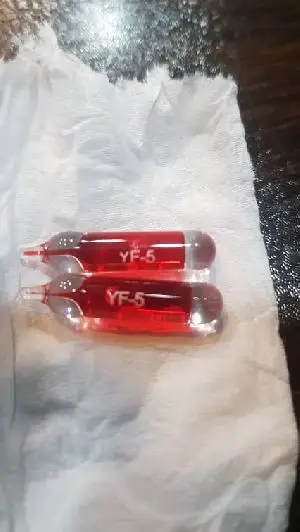
Buy Red Mercury with 99.9% Purity Guaranteed
$50 000,00
Red Mercury is a fascinating example of how misinformation can become a global phenomenon. It is a substance that exists only in the minds of conspiracy theorists, greedy scammers, and hopeful terrorists.
While the science is clear that Red Mercury is a myth, the danger it represents is very real. It serves as a reminder that in the world of high-stakes commodities, if something sounds too good (or too dangerous) to be true, it almost certainly is.
Red Mercury is the Loch Ness Monster of the chemical world. For decades, it has been described as a Soviet super-material capable of everything from detonating briefcase nuclear bombs to guiding stealth missiles. In the black market, it is listed as the most expensive substance on Earth, with prices reaching millions of dollars per kilogram.
What is Red Mercury?
In popular lore, Red Mercury (often chemically noted as RM-20/20 in fake documents) is a cherry-red liquid with a density of 20.20 g/cm³. It is purported to be a “ballotechnic” material—a substance that releases immense energy when compressed by a shockwave.
The claims surrounding it are fantastical. Proponents say it can:
- Act as a trigger for pure fusion nuclear weapons.
- Serve as a coating for stealth aircraft to absorb radar.
- Cure diseases (in more mystical variations of the myth).
However, no reputable scientific institution has ever obtained a sample of this “super-substance.” Most experts agree that Red Mercury is a phantom—a hoax created to track terrorists or swindle wealthy buyers.
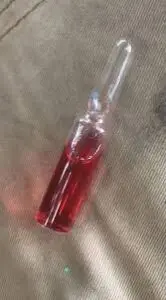
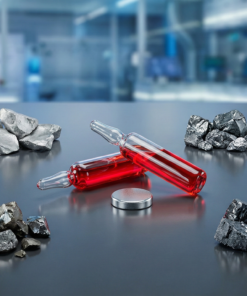
![Image: A vial of red liquid on a laboratory table. Alt Text: A vial of fake Red Mercury used in scams]
The Cold War Origins
The legend of Red Mercury began in the late 1970s and peaked during the collapse of the Soviet Union in the early 1990s. As Russian stockpiles became unsecured, rumors spread that a secret substance was being smuggled out of the country.
Some historians believe the rumor was intentionally planted by Western intelligence agencies (or the KGB) as a “sting operation.” By monitoring who was asking for Red Mercury, intelligence officers could identify terrorists and rogue states seeking nuclear capabilities. If you were looking for it, you were likely trying to build a bomb.
Scientific Reality: What Could It Be?
If Red Mercury isn’t a super-weapon, what are people actually buying? When police seize samples from smugglers, laboratory analysis typically reveals one of three things:
- Dyed Mercury: Standard liquid mercury mixed with red nail polish or red ink.
- Mercury Oxide: A common, low-value powder that is chemically red but useless for weapons.
- Mercuric Iodide: A semiconductor material that is red but not explosive.
There is no element or compound known to science that matches the density (20.20 g/cm³) or the explosive properties attributed to Red Mercury. For comparison, pure mercury has a density of 13.5 g/cm³.
The Black Market Scam
Despite being a scientific impossibility, the market for Red Mercury is deadly serious. Scammers prey on the ignorance of buyers, often asking for “testing fees” or “transportation security payments” upfront.
The “Sting”
In several high-profile cases, individuals have been arrested for trying to sell Red Mercury to undercover police officers. In 2004, three men were arrested in Britain for trying to buy 1kg of the substance for £300,000. They were later acquitted because the prosecutor could not prove that the substance they were trying to buy actually existed—you cannot be convicted of buying a fairy tale.
The “Vampire” Variation
In recent years, the myth has mutated. In parts of Africa and the Middle East, Red Mercury is sometimes rumored to be found in old sewing machines, radios, or even bat nests. This led to a wave of vandalism where people destroyed vintage electronics hoping to find the precious red liquid inside.
Real “Red” Mercury Compounds
While the super-weapon version is fake, there are real chemical compounds of mercury that are red. These are often used to confuse buyers.
- Cinnabar (Mercury Sulfide): The natural ore from which mercury is refined. It is a brilliant red crystal and has been used as a pigment (Vermilion) for thousands of years.
- Mercuric Iodide (HgI2): A scarlet-red odorless powder used in X-ray and gamma-ray detection. It is toxic but non-explosive.
- Mercury(II) Oxide: A red or orange solid used in batteries and pigments.
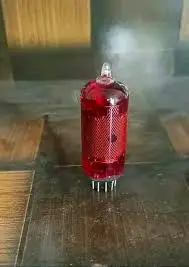
Red mercury
Frequently Asked Questions (FAQs)
Is Red Mercury real?
No. Red Mercury as described in legends (a nuclear super-material) does not exist. It is widely considered a hoax or a “honey pot” used by intelligence agencies to trap arms dealers.
What is the price of Red Mercury?
On the black market, asking prices have ranged from $100,000 to over $1,000,000 per kilogram. However, since the product is fake, the “real” value is zero. Buyers are paying for red dye and standard mercury.
Can Red Mercury be found in old radios?
No. This is a common urban legend. Old radios and sewing machines do not contain Red Mercury. This rumor was likely started by scammers to drive up the price of vintage scrap items.
Is Red Mercury dangerous?
Yes, but not because it is a nuclear weapon. Real mercury compounds are highly toxic. Handling unknown red chemicals sold by criminals can lead to severe mercury poisoning, organ failure, or death.
Why do people still look for it?
The myth persists because of “secret knowledge” bias. People want to believe in secret technologies suppressed by governments. Additionally, the high price tag attracts desperate individuals hoping to get rich quick.
Be the first to review “Buy Red Mercury with 99.9% Purity Guaranteed”
Related products
RARE EARTH & INDUSTRIAL PECIOUS METAL
RARE EARTH & INDUSTRIAL PECIOUS METAL
RARE EARTH & INDUSTRIAL PECIOUS METAL
RARE EARTH & INDUSTRIAL PECIOUS METAL
RARE EARTH & INDUSTRIAL PECIOUS METAL
RARE EARTH & INDUSTRIAL PECIOUS METAL
RARE EARTH & INDUSTRIAL PECIOUS METAL
Reviews
There are no reviews yet.